

DiSC: Why We Communicate Differently
A DiSC personality guide to understanding people and learning to love them better.
What is the DiSC Personality Screener?
There are so many personality tests out there today that it can get pretty exhausting.
Most people tend to fall into one of two camps. There are the people who are all about personality tests and have taken just about every test known to man. On the other side of the spectrum, there are the people who couldn’t care less about them.
Ironically, both groups can find themselves frustrated.
Those of us on the “over-educated” side of the personality-test spectrum (myself included) often want to know everyone’s Enneagram type, Myers-Briggs personality, attachment style, and probably their Hogwarts house while we’re at it. The problem is that most people don’t know their results, and even fewer are willing to sit down and take a 100-question survey just to answer your question.
If you have ever found yourself frustrated by the overcomplicated world of personality tests, allow me to introduce you to one of my personal favorites: DiSC.
DiSC is one of the simplest personality frameworks to understand. Rather than trying to explain every possible aspect of someone’s personality, it focuses primarily on behavioral tendencies and communication styles: how people tend to approach tasks, interact with others, respond to their environment, as well as what tends to motivate them.
It is simple enough that you can often begin noticing these tendencies in everyday interactions without needing someone to take a lengthy assessment.
So, if you’re rolling your eyes at the thought of “yet another personality test,” stick with me. This one isn’t nearly as complicated as you might think.
So, Why DiSC?
Anyone who has taken a Psychology 101 course, scrolled through PsychologyTok, or has a particularly “well-informed” family member has probably heard of personality tests.
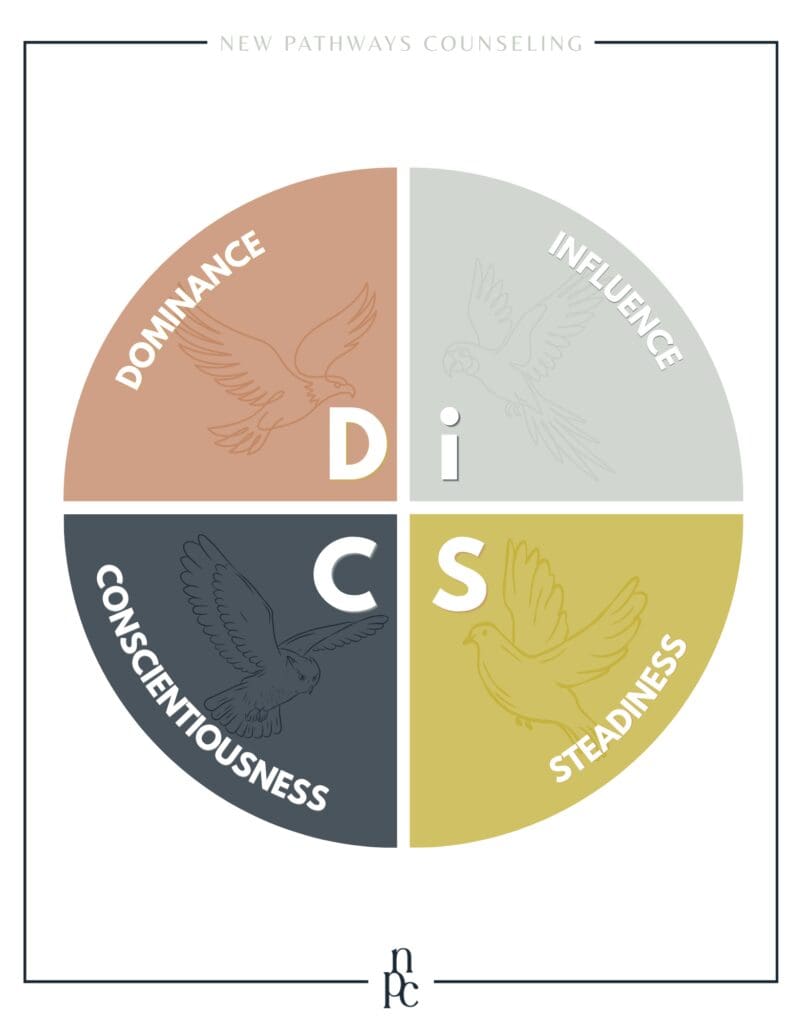
Myers-Briggs gives you 16 personality types. The Enneagram gives you 9 types. DiSC keeps things much simpler with 4 primary behavioral styles:
- D – Dominance
- i – Influence
- S – Steadiness
- C – Conscientiousness
Once you understand the four styles, you may start recognizing them in yourself, and more importantly, in the people you interact with every day.
Here are the four main types and what makes them unique:
D — Dominance
These individuals are often the leaders of the group.
Think Maui from Moana, Scar from The Lion King, or even Winston Churchill.
These individuals tend to be competitive, goal-oriented, decisive, and focused on accomplishing the task at hand, often taking charge in the process. When there is something that needs to get done, the D is often ready to figure out how to make it happen.
They are the people who might have been voted “Most Likely to Succeed.”
Motivated by: Getting results
Energized by: Progress, achievement, and accomplishing goals
Need: Direct communication, autonomy, and people who follow through
In relationships, a “D” may become frustrated when conversations feel like they’re going nowhere. They often want to identify the problem, make a decision, and move forward.
That can be one of their biggest strengths, but it can also create tension when their partner or friend needs more time to process emotions before jumping into solutions.
A “D” may often be thinking, “Okay, what’s the problem and how do we fix it?”
I — Influence
The first thing that comes to mind when you hear “influencer” might be social media. But long before Instagram and TikTok, the “I” personality was already at the center of attention.
When you imagine an “I,” think Genie from Aladdin, Olaf from Frozen, or Kevin Hart.
These individuals are often the life of the party.
They tend to enjoy social interaction and may be enthusiastic, talkative, expressive, and friendly. They often gain energy from being around other people and enjoy making connections.
They might have easily been voted “Class Clown”
Motivated by: Connection, recognition, and being included
Energized by: Being around people and experiencing things
Need: To be heard, appreciated, and included
In relationships, an “I” may place a lot of value on conversation, excitement, affirmation, and shared experiences. They often think, “Do they like me?”
S — Steadiness
These are often the quieter individuals in the room.
For these, you can imagine Mr. Rogers, Winnie the Pooh, or Bob Ross.
They don’t necessarily seek attention and may be more soft-spoken than the other personality styles. They tend to be thoughtful and may prefer to listen before speaking rather than immediately saying everything that comes to mind.
They are often grounded, supportive, patient, and excellent collaborators.
They would probably be voted “Best Listener.”
Motivated by: Helping others, showing appreciation, and offering support
Energized by: Working together, calm environments, and creating a sense of safety
Need: Stability, harmony, and respectful communication
In relationships, S personalities often value consistency and emotional security. They may be deeply committed to their partner and family but can struggle when relationships become unpredictable, highly confrontational, or constantly changing.
They may also have a tendency to keep the peace, sometimes at the expense of expressing what they actually think or need.
An S might think, “I don’t want to make this into a big deal.”
C — Conscientiousness
These individuals are known for being thoughtful, analytical, and focused on doing things well.
They’re often looking for ways to solve problems, improve systems, and figure out the best way forward.
For this one, think Albert Einstein, WALL-E, or Owl from Winnie the Pooh.
If there isn’t a problem to solve, just give them a little time.
They may find one.
They can become frustrated when a situation doesn’t have a clear solution or when people don’t seem to be following a logical process.
Motivated by: Solving problems and doing things well
Energized by: Finding an effective and accurate solution
Need: Clear expectations, accuracy, and enough information to do things “the right way”
In relationships, C personalities may show love by trying to solve problems, anticipate needs, or make things better.
They might often be thinking “Is this correct?”
DiSC Secondary Tendencies
Most people aren’t exclusively one type. Instead, they often have a primary style along with one or more secondary tendencies. I like to think of those secondary types as the “sidecar.”
For example, I tend to identify most strongly with S (Steadiness), with strong C (Conscientiousness) tendencies. This would put me in the camp of a problem solver whose approach is supportive but thought out, wanting to understand things deeply in order to get them right.
Why Does DiSC Matter in Relationships?
So, why does any of this matter?
Because the people we love don’t necessarily experience the world the same way we do.
In every friendship, marriage, parent-child relationship, workplace, or family, it is helpful to understand what energizes the people around you.
For example, “D” and “I” personalities tend to be more people-facing and externally energized, while S and C personalities may be more comfortable with quieter environments and individual work.That doesn’t make one style better or worse; it simply means they may approach the same situation differently.
You can also see differences in how people approach tasks.
D and C personalities tend to be more task-oriented. They often want to identify the problem, figure out what needs to happen, and get the job done.
Think: assembling IKEA furniture.
The D might say, "Let's just get this thing build."
The C might say, “Wait. We need to read the instructions first.”
Meanwhile, the i and S personalities tend to be more people-oriented. One may want to talk through the experience, while the other may be more comfortable listening and helping everyone work together.
At a family reunion, the “I” might be telling a story to everyone at the table while the S is happily listening. Eventually, the D may interrupt with, “Okay, so what are we actually doing next?” Meanwhile the C is already at work reading the board game instructions.
Using DiSC Well
Understanding DiSC can become incredibly helpful. It can help you understand the people on your team, in your house, and in your relationships.
That doesn’t mean you should put people into boxes. It also doesn’t mean that every D will behave the same way or every C will respond identically.
And it certainly doesn’t mean that you should use someone’s personality type as an excuse for unhealthy behavior.
There is no “good” or “bad” DiSC style. Healthy people recognize their natural strengths while continuing to grow in areas that don’t come as naturally to them. No one person has mastered all four styles, but a well-rounded person can learn to display traits from all four when the situation calls for it.
So, the goal isn’t to figure out someone’s DiSC type so you can win an argument with them. The goal is to understand them well enough to love them better.
The next time you find yourself frustrated with someone, pause for a second and ask yourself: “What might this person need from me right now?” And maybe what they need isn’t what you would need in the same situation.
The more you understand the people in your life, the better equipped you will be to serve them, communicate with them, and love them in ways you may not have thought about before.
*Basic DiSC model developed from William Moulton Marston’s theory.
Written by Tyler Linton, MFTA
